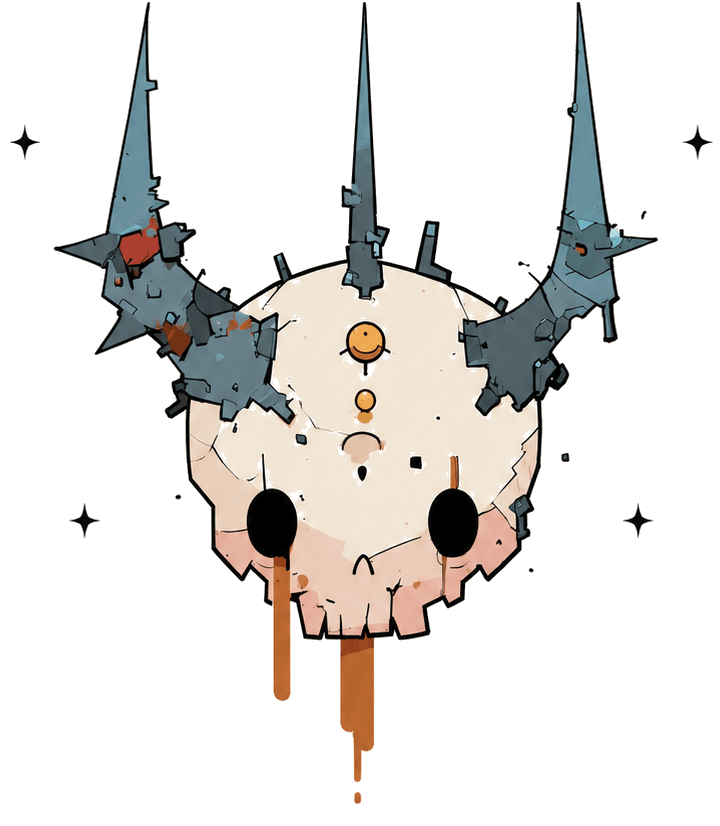
Wasteland
Wasteland is an art-driven NFT collection built around rejects, discarded objects, forgotten creatures, broken machines, strange transports, and ruined places that somehow found their place in the Wasteland.
Around the collection is an optional ecosystem built on:
Wasteland NFTs → $WASTE → Materials → The Forge → Relics
Holding a Wasteland NFT is required to use the Forge.
$WASTE & Materials
$WASTE is the primary ecosystem resource.
Holding
Every Wasteland accrues $WASTE for as long as it is continuously held, from a fixed emission written into the contracts. Emission runs for eight years — from 16 September 2026, 15:00 UTC, to 14 September 2034, 15:00 UTC — and then stops.
Continuity is read from the Wasteland contract's own ownership record, so it is exact. Any transfer — a sale, a gift, a move between two wallets with the same owner — forfeits the piece's unclaimed $WASTE and restarts its clock for the new holder. Claiming never resets it.
SchedulePer piece at 1.0x
A piece accrues 200 $WASTE a day in the first year, and the daily amount halves every 365 days:
- Year 1
- From 16 Sep 2026: 200 $WASTE a day, 73,000 for the year.
- Year 2
- From 16 Sep 2027: 100 $WASTE a day, 36,500 for the year.
- Year 3
- From 15 Sep 2028: 50 $WASTE a day, 18,250 for the year.
- Year 4
- From 15 Sep 2029: 25 $WASTE a day, 9,125 for the year.
- Year 5
- From 15 Sep 2030: 12.5 $WASTE a day, 4,562.5 for the year.
- Year 6
- From 15 Sep 2031: 6.25 $WASTE a day, 2,281.25 for the year.
- Year 7
- From 14 Sep 2032: 3.125 $WASTE a day, 1,140.625 for the year.
- Year 8
- From 14 Sep 2033: 1.5625 $WASTE a day, 570.3125 for the year.
Over eight years that is 145,429.6875 $WASTE for a piece held throughout, and at most 484,717,148.4375 across all 3,333 pieces: 48.47% of the supply cap, inside the emitter's 500,000,000 holding budget. The first year is the largest, at most 243,309,000. $WASTE forfeited by a transfer is never minted, so what is minted can only come in under these figures.
AgeFive bands
Each piece's share is weighted by the multiplier of its Age band:
- Age 5–49
- 0.8726x: 174.52 $WASTE a day and 63,699.8 in the first year, 126,901.94 over all eight.
- Age 50–149
- 0.9344x: 186.88 $WASTE a day and 68,211.2 in the first year, 135,889.5 over all eight.
- Age 150–299
- 1.05x: 210 $WASTE a day and 76,650 in the first year, 152,701.17 over all eight.
- Age 300–599
- 1.2x: 240 $WASTE a day and 87,600 in the first year, 174,515.62 over all eight.
- Age 600–998
- 1.5x: 300 $WASTE a day and 109,500 in the first year, 218,144.53 over all eight.
Across all 3,333 pieces the multipliers sum to 33,330,000 basis points, an average of exactly 1.0x, so Age moves $WASTE between pieces without adding to it. The emitter only starts once every piece's multiplier is recorded on chain and the sum is exact.
Claiming
A claim is a transaction from the holding wallet carrying up to 25 pieces, with a proof of each piece's ownership record at a block no more than about five minutes old, which the emitter checks against the chain's own block history. The $WASTE is minted straight to that wallet. Unclaimed $WASTE waits for as long as the piece stays put, including after emission ends.
Control
The token and the emitter are administered through a 48-hour timelock that only the project's Safe can propose to. The Safe can act at once only to restrict issuance — halting a minter, lowering the rate, pausing claims — and pieces keep accruing while claims are paused. Restoring the rate, unpausing, lowering a budget or upgrading a contract waits 48 hours in public, and the rate can never exceed the published schedule.
Supply is capped at 1,000,000,000 $WASTE for life, and nothing was minted at deployment. The token fixes the budgets inside that cap — 600,000,000 for the holding emitter, 100,000,000 of it reserved for Sets, and 400,000,000 for the burn vault — and a budget can be lowered but never raised.
BurningLater
Eligible unwanted assets may be burned in exchange for $WASTE.
Materials
$WASTE can then be used to acquire and refine Materials used inside the Forge.
Materials progress from basic resources into more advanced components and Catalysts.
Materials go into the Forge.Artifacts come out.
Forge Outputs
The Forge creates more than one kind of collectible output.
Wasteland uses three primary forged artifact classes:
Relic
The core artifact category. Relics may include:
- legendary swords and weapons
- talismans and charms
- eyeballs and biological artifacts
- masks and crowns
- totems and idols
- cursed or sacred objects
- strange objects with unknown purposes
SanctumRelic Structure
Rare forgeable structures and constructed relic sites. Sanctums may include:
- altars
- churches
- shrines
- towers
- ruins
- monuments
- other rare Wasteland structures
CarrierRelic Mount
Forgeable rideable or transport-based artifacts. A Carrier is defined by what it does, not what form it takes. Carriers may include:
- beasts
- machines
- vehicles
- cyborg creatures
- walkers
- flyers
- refurbished war trucks
- pterodactyl cyborgs
- other mobile or rideable Wasteland entities
The artwork and lore define the forged object first. Its recipe, rarity, and supply are then built around it.
Artifact Tiers
Every forged output belongs to one of five tiers:
- D — Discarded
- Crude or broken artifacts.
- R — Reclaimed
- Recovered objects given new purpose.
- T — Tempered
- Advanced artifacts deliberately transformed or strengthened.
- H — Hallowed
- Rare objects of historical, ceremonial, or legendary importance.
- A — Ascended
- The highest class of Wasteland artifact.
These tiers can apply to a Relic, a Sanctum, or a Carrier.
Tier and supply are separate. Two artifacts of the same tier may have very different maximum supplies.
The Forge
The Forge has two modes.
Recipe Forging
The artifact has already been discovered and its recipe is known.
Correct recipe + available supply = successful Forge
Experimental Forging
The recipe is still hidden.
Players experiment with combinations of $WASTE and Materials in an attempt to discover an Unknown artifact.
Wrong recipes fail. Correct hidden recipes become eligible for Forge Activation RNG.
Failed experiments may also destroy Materials.
Unknown Artifacts
Every forgeable artifact appears in the public Master List.
Discovered outputs show their artwork, name, tier, and recipe. Undiscovered outputs appear as a:
Unknown entries can exist at any tier and in any artifact class. That means an undiscovered slot could hide a Relic, a Sanctum, or a Carrier.
When one is successfully discovered:
- its artwork is revealed
- its name and recipe become public
- the first discoverer is recorded
- the Wasteland NFT used may become part of its history
Future forging of that revealed recipe becomes deterministic, subject to remaining supply.
Every Unknown recipe is committed on-chain as a cryptographic hash before launch. The recipe stays hidden; the commitment does not. On discovery the values behind that commitment are published with the artifact, so anyone can check that what was found is what was sealed — and that no recipe was altered while experiments were running.
Sanctums & Carriers
The Forge is not limited to personal artifacts. Wasteland NFTs may also extend into larger and more specialized forged outputs.
SanctumsRelic Structure
Sanctums are forgeable locations or constructed relic forms such as altars, churches, shrines, towers, ruins, and other rare structures.
Their recipes follow the same general forging system as other outputs, but may require additional ingredients unique to the structure itself.
A Sanctum is also a place to forge from. Holding one lowers the Forge Stress of an attempt by a single step, to a floor of Low — a standing reduction in what a failed experiment costs, not a better chance that a correct one succeeds.
CarriersRelic Mount
Carriers are forgeable rideable or transport-based entities. A Carrier may be a living creature, a machine, a war truck, a flying beast, a mechanical walker, or a hybrid form.
To access certain Carrier recipes, the player may need to hold an eligible Wasteland Mount NFT as part of the forging requirements.
Carrier recipes use the same core $WASTE, Materials, Catalysts, Forge Stress, and discovery mechanics as the rest of the Forge, with additional ingredients unique to the Carrier being made.
A Carrier is also a way to move Material. Holding one shortens the time Materials take to process, feeding the Forge faster without changing what any attempt produces.
Relics, Sanctums, and Carriers are made by one system and each holds a place in it: Relics are what the Forge is for, Sanctums temper the cost of failing to make them, and Carriers shorten the line that supplies them.
Forge Stress, RNG & GOO
Experimental Forging contains two forms of randomness:
Forge Activation
Determines whether a correct hidden recipe successfully produces its artifact.
Material Breakage
Determines what may be lost when an experiment fails.
More advanced combinations create greater Forge Stress:
- 01Low
- 02Elevated
- 03High
- 04Severe
- 05Critical
Higher Stress means more exposure at Material Breakage. Stress governs what a failure costs, not whether a correct recipe fires.
GOO
GOO is an optional protection resource. It may protect selected Materials from breakage.
GOO does not increase success probability, improve RNG, reveal recipes, or increase rarity. Its purpose is protection only.
GOO and a Sanctum both answer breakage, and they answer it differently: GOO shields the Materials you select, a Sanctum lowers the Stress the whole attempt runs at. Neither touches Forge Activation.
The Forge Anchor & Standing Effects
Every Forge attempt uses one selected Wasteland NFT as its Forge Anchor.
Experimental Forge success may be influenced by:
Hold Affinity
Longer continuous holding can improve Forge Activation. It is read from the same per-piece ownership record a $WASTE claim reads, so the Forge and the emitter cannot disagree about how long a piece has been held.
Rarity Affinity
Rarer Wasteland NFTs may receive a smaller additional bonus.
Holding duration is intended to matter more than rarity. Bonuses do not stack across multiple NFTs, and wrong recipes remain unsuccessful regardless of Affinity.
A Wasteland used to make an important discovery may also become permanently associated with that artifact in the Archive.
Standing Effects
An attempt may also carry the passive effect of a held Sanctum and a held Carrier. One of each applies at most: holding several of a class does not compound, and the two do not combine into a larger single effect.
The Anchor remains the only thing that influences Forge Activation. Sanctum and Carrier effects sit outside it — one on breakage, one on processing time — so no amount of collecting improves the odds that a correct hidden recipe fires.
Seasonal Artifacts
Wasteland may collaborate with other NFT collections through limited Seasonal Forge events. Partner projects may introduce outputs inspired by their own lore.
A Seasonal recipe may require:
$WASTE + Wasteland Materials + Partner Ingredient
Partner ingredients may include:
- a project's fungible token
- an eligible NFT from that collection
Seasonal outputs may be Relics, Sanctums, or Carriers. They may also begin as Unknown.
When a Season closes, forging may end permanently while its outputs remain visible in the Wasteland Archive. An undiscovered Seasonal output may remain:
Never discovered.
The Wasteland Loop
- 01HoldOwn a Wasteland NFT; it accrues $WASTE for as long as you hold it.
- 02BurnTurn eligible unwanted assets into $WASTE.
- 03ProcessCreate Materials.
- 04AnchorChoose a Wasteland NFT.
- 05ForgeCreate a Relic, Sanctum, Carrier, or experiment with an unknown recipe.
- 06ProtectOptionally use GOO.
- 07DiscoverReveal hidden artifacts.
- 08CollectBuild your Wasteland collection.
- 09ArchiveBecome part of Wasteland history.
After Archive, the loop returns to Hold.
The Forge is optional. Collectors can simply own Wasteland for its artwork and characters without participating in $WASTE, Materials, or forging.